The 1941 bombardment of Košice was one of the moments that fundamentally influenced thinking about the protection of cultural heritage in the city. It was during this period that experts began to realize that cultural heritage requires special preventive measures in times of war.
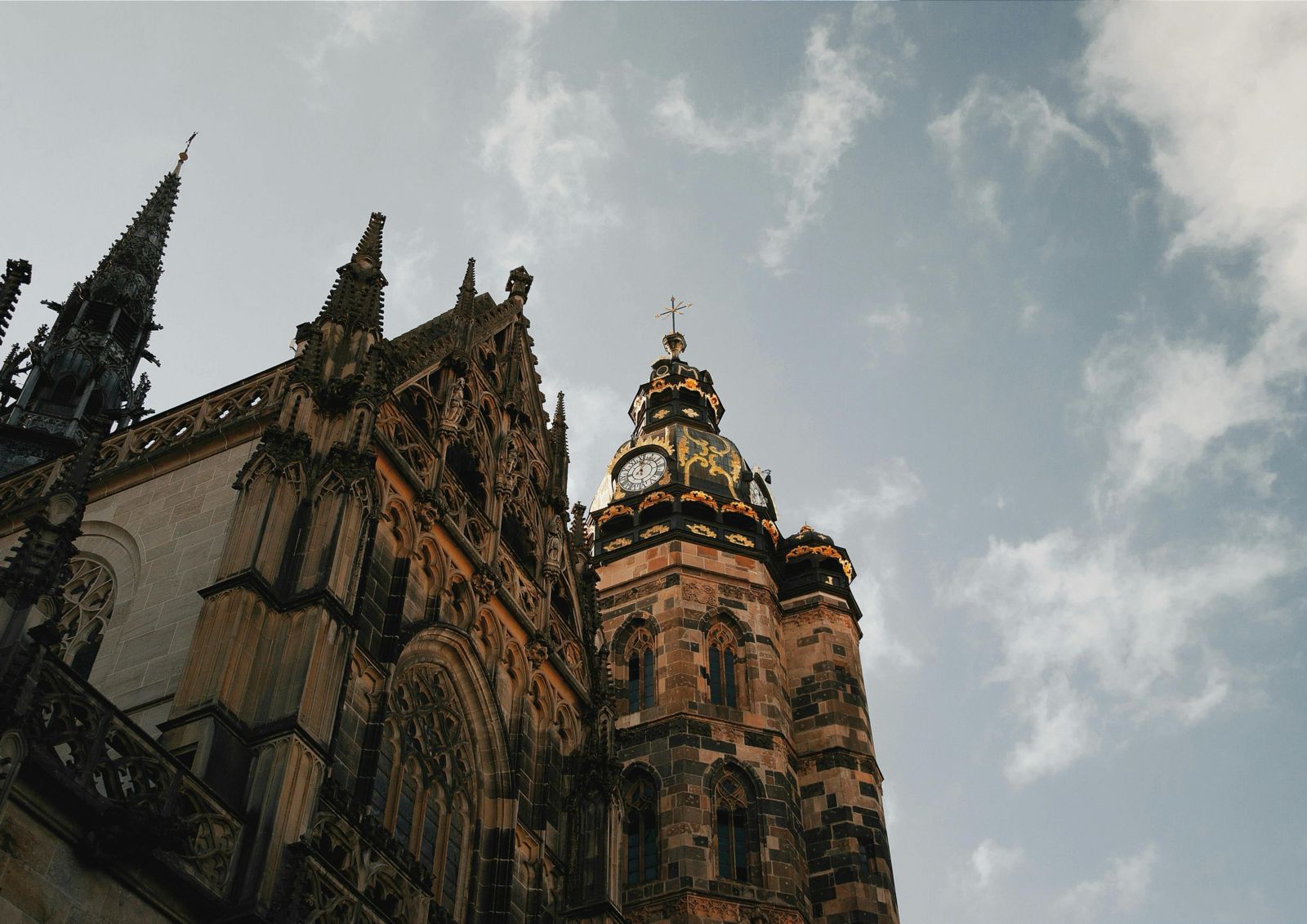
One of the most significant decisions was the systematic safeguarding of the most valuable items from St. Elisabeth’s Cathedral and from the former Rákóczi Museum, today’s East Slovak Museum in Košice. In 1943, the process of packing, cataloging, and covertly relocating the artworks to a safer location outside the city began. These items included mainly medieval altars, panel paintings, woodcarvings, pictures, and other objects of high cultural and historical value. The summer residence of the Košice Bishopric in the village of Hejce, located in present-day Hungary, was chosen as the storage site. The property featured extensive and deep cellars, which provided more stable microclimatic conditions as well as protection against potential bombardment.
From today’s perspective, this procedure can be characterized as an example of early prevention. Professional staff correctly identified the risks associated with military operations, fires, air raids, and secondary damage. The collections were not left to chance but were relocated before any direct destruction could occur.
This historical experience demonstrates that the foundation of crisis management in the field of cultural heritage is the ability to act in time. Prevention is generally more effective, less expensive, and safer than the subsequent salvage of damaged collections.
Between April and June 1943, the items were gradually packed, loaded, and transported to premises that possessed better conditions for their survival during the war period. Secrecy, controlled access, and physical security of the space played an important role. One of the cellar entrances was even bricked up to restrict the movement of unauthorized persons.
During the war, the collections remained relatively well protected. However, a major problem arose only after the arrival of Soviet troops at the turn of 1944 and 1945. The hidden crates were discovered, some were opened, and a portion of the items was damaged. Although most of the collections were preserved, it became clear that the crisis did not end with the conclusion of the fighting itself.
After 1945, the protection of cultural heritage entered a completely new situation. Košice once again became part of Czechoslovakia, but the artworks were still stored in Hungary. Their return became the subject of administrative, political, and diplomatic negotiations. The Czechoslovak side demanded their return; however, the Hungarian side responded slowly, partly due to its own domestic political problems and strained bilateral relations.
In 1945, a portion of the collections was successfully transported back to Košice without the official consent of the central Hungarian authorities. A definitive solution came only in 1946, when the remaining artworks were handed over to the Czechoslovak side. However, even this process is not fully and accurately documented in historical sources. It is not entirely clear how many crates were ultimately returned and in what condition the items were. Archival documents from the post-war period point to the need for conservation and restoration interventions, which continued for several years after the war.
The case of Hejce therefore shows that crisis management of cultural heritage cannot end with evacuation. A return plan, definition of responsibilities, and documentation of the items’ condition are equally important.
The experience from 1943 to 1946 is also important for the present day. It shows that museums and cultural institutions need clear rules, methodologies, and links to the state’s crisis management system. Professional will to protect collections is not enough. Competences, documentation, planning, cooperation with public administration, and a functional legal framework are also required.
Currently in Slovakia, the protection of collection items during emergencies is not regulated by a single regulation. The basis is Act No. 42/1994 Coll. on Civil Protection of the Population, which addresses the protection of life, health, and property during emergencies. However, it perceives cultural heritage mainly as part of general property. Specific obligations of museums and galleries are established by Act No. 206/2009 Coll. on Museums and Galleries, which regulates the protection, cataloging, and management of collection items. At the same time, Act No. 49/2002 Coll. on the Protection of Monuments Fund applies to the protection of historical buildings. Crisis situations at the national level are addressed by Act No. 227/2002 Coll. on State Security and Act No. 179/2011 Coll. on Economic Mobilization, but neither contains specific provisions on the protection of cultural heritage. In the area of occupational safety, Act No. 124/2006 Coll. on OSH also applies, though it focuses primarily on the protection of employees. The methodological basis for the protection of cultural heritage is the Methodological Guideline of the Ministry of Culture of the Slovak Republic No. 2/2016 for the protection of cultural heritage in crisis situations. This sets out procedures for the protection of collections, evacuation, and sheltering of cultural objects. Its weakness, however, is that it is a departmental document without a solid anchor in the civil protection system.
Although most major museums in Slovakia possess internal collection protection plans, evacuation plans, or emergency procedures, these documents are generally not publicly accessible for security reasons. Publicly available information includes mainly general information on collection fund protection, depository security, and preventive conservation. Exceptions include professional publications and methodological documents, which confirm that crisis planning is an important part of cultural heritage protection in Slovak museology.
An analysis of the position of the Monuments Board of the Slovak Republic, the Ministry of Culture of the Slovak Republic, and the civil protection system shows that although the Slovak Republic possesses a basic legislative and methodological framework for the protection of cultural heritage in crisis situations, this system exhibits several significant shortcomings.
A fundamental problem is the absence of a clear position for cultural heritage within the state security system. While the protection of the population, energy infrastructure, healthcare, or transport is firmly integrated into the crisis management system, the protection of museums, galleries, and monuments remains predominantly a departmental matter of the Ministry of Culture of the Slovak Republic. In the civil protection system, cultural heritage is usually assessed only as a general category of property, thereby losing its irreplaceable historical and social value.
Another problem is the fragmentation of competences. The protection of monuments falls under the competence of the Monuments Board of the Slovak Republic, collection items are handled by the Ministry of Culture, civil protection is provided by the Ministry of Interior of the Slovak Republic, and the museums and galleries themselves are subject to various founders. In the event of a large-scale crisis situation, ambiguity may arise as to who bears the ultimate responsibility for decision-making, collection evacuation, or setting protection priorities.
A significant weakness is also the absence of specialized intervention capacities. In Slovakia, there is no institution or expert team prepared to operationally intervene when museums, galleries, or historical buildings are damaged during fires, floods, wartime events, or other extraordinary situations. In a critical situation, the sector remains dependent on cooperation with firefighters, the police, or local governments, which may not possess the specialized knowledge required to protect cultural values.
Another problem is the absence of systematic cooperation between civil protection authorities and cultural institutions. Although the Methodological Guideline of the Ministry of Culture of the Slovak Republic No. 2/2016 envisions cooperation with district offices, the police, and other state components, in practice, there is no unified system of regular joint exercises, verification of evacuation plans, or coordinated training of museum and gallery employees. In many cases, contacts between museums and crisis management departments are based more on personal relationships and individual initiative rather than on binding systemic mechanisms.
The Ministry of Interior of the Slovak Republic is the main sponsor of civil protection, crisis management, economic mobilization, and coordination of interventions during emergencies. Through its crisis management section, district offices, the Fire and Rescue Corps, the Police Corps, and other components of the Integrated Rescue System, it ensures the protection of life, health, property, and essential state functions during emergencies, states of emergency, states of war, or war. In strategic documents, however, the protection of cultural heritage does not constitute an independent priority. A significant role is also played by district offices, specifically their crisis management departments. In many cases, these are the decisive link between the state, local government, and rescue services. They participate in the preparation of crisis plans, coordinate evacuations, and ensure the operation of crisis staffs. Paradoxically, however, these are organizations that generally do not possess experts in the protection of cultural heritage, collection items, or the monuments fund. Consequently, in critical moments, decisions regarding the fate of collections, funds, or historical buildings may be made by individuals lacking specialized knowledge about their cultural value, methods of handling, or evacuation conditions.
Although the Government of the Slovak Republic, by Resolution No. 334/2025, approved the Conceptual Reform of Crisis Management and Civil Protection for the period 2025–2030, the protection of cultural heritage, museums, galleries, and collection funds is practically absent from the approved strategic document. The reform framework thus confirms that cultural heritage is not integrated among the priority areas of national crisis management.
Another problem is the low level of systemic readiness within the museum sector. Although the 2016 methodological guideline presumes the existence of plans for the protection, evacuation, and sheltering of collections, there is no publicly accessible mechanism to monitor their quality, updates, or practical verification. It is unknown to what extent individual museums regularly conduct crisis exercises, test evacuation procedures, or verify the readiness of their employees. In many cases, a plan may exist only formally, without any real verification of its functionality.
Particularly alarming is the absence of a national priority list for the protection of cultural heritage in the event of a large-scale crisis or armed conflict. Although lists of national cultural monuments and monuments with restoration priority exist, it is unclear which museums, galleries, depositories, or collections should be protected preferentially when capacities are scarce. In a crisis situation, this could lead to improvised decision-making without pre-established criteria.
Overall, it can be stated that the biggest problem is not a lack of legislation or methodological documents, but rather the absence of their full integration into the state’s crisis management system. In Slovakia, the protection of cultural heritage remains perceived more as a professional cultural agenda rather than as a component of national security. Unless better interconnection is achieved between the Ministry of Culture of the Slovak Republic, the Monuments Board of the Slovak Republic, the Ministry of Interior of the Slovak Republic, and the museums and galleries themselves, the protection of cultural heritage during major crises will depend primarily on the individual readiness of each institution. This presents a significant risk to the preservation of cultural values, which are an irreplaceable part of the historical memory of the Slovak Republic. For the future, it is necessary that the protection of cultural heritage becomes a natural part of civil protection and state crisis management. Cultural heritage should be perceived as a special category of property with extraordinary and irreplaceable value. It would be appropriate to introduce concepts such as “cultural heritage of special significance” or “critical cultural values” into legislation.
The historical example of the evacuation of Košice artworks to Hejce is therefore not merely an episode from the history of World War II. It is also a timely reminder that the protection of cultural heritage must be planned, professionally managed, and systemically anchored. Cultural values cannot be replaced by financial compensation. If they are lost once, a piece of historical memory is lost with them.
PhDr. Mgr. Gabriel Viszlay, PhD.
Praktický návod pre verejnosť a stavebníkov. Správna reakcia v prvých minútach po objavení archeologického nálezu je absolútne
Praktický vizuálny návod pre inštitúcie Živelná pohroma vyžaduje presný postup, chladnú hlavu a okamžité konanie. Táto
Presun zbierkových predmetov, nech už ide o štandardnú výpožičku alebo urgentnú krízovú evakuáciu, patrí k najrizikovejším